
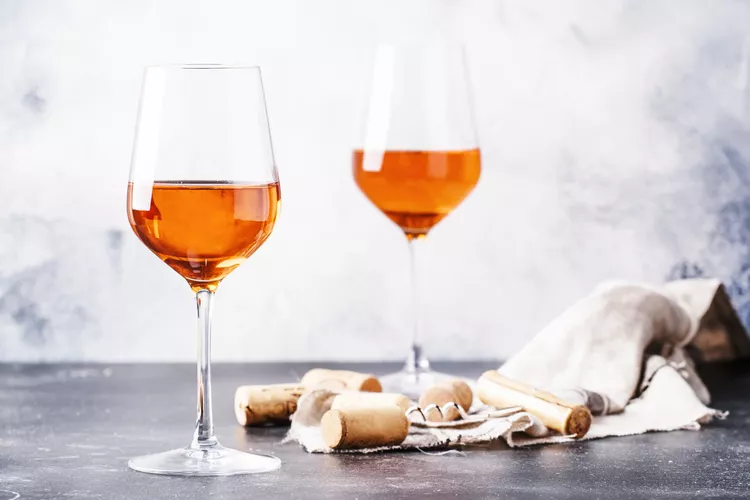
Whether you’re totally new to the world of wine or have a fully-stocked cellar, chances are high that you’re familiar with the key players: red wine, white wine, rosé wine, and sparkling wine. It’s high time we officially induct a new member to this list: orange wine.
What is orange wine? This guide is here to answer that question, plus to spill about what orange wine tastes like, the best food pairings for orange wine, as well as the ideal temperature and glassware to serve it so you can make this up-and-coming wine style your main squeeze.
What Is Orange Wine?
Orange wine is produced in a similar manner to red wine, but uses white grapes instead. It might sound surprising, but white grapes do have some pigment in their skins.
“The juice itself may be very light, but the skins hold color,” explains Melanie Mann, an Austin, Texas-based global wine category manager at Whole Foods Market. “When you let the skins of white grapes macerate, or mix, with the juice, this will start lending color and flavor.”
After a week or up to a year or two of maceration with the stems and skins, the juice can take on colors ranging from golden and light orange to amber and saffron. At a certain point, the winemaker removes the stems and skins from the fermented juice, and the orange wine is often aged a bit more on its own.
A few years ago in the U.S., you likely had to hunt pretty hard to find orange wine on restaurant menus or in wine shops. It’s actually nothing new at all, though.
Orange wine is an ancient style of wine that historians believe dates back to at least 6,000 B.C., and it likely started in the area of Eastern Europe now known as Georgia, explains Elyse Lovenworth, a Philadelphia, Pennsylvania-based lead sommelier for the premium online wine shop Sommsation. Today, producers in Italy, France, California, Oregon, New York, Australia, Chile, and many other wine regions are all creating high-quality orange wines.
“Orange wine can be made successfully from most white wine grapes, so wherever you’re finding delicious white wines, orange wines are probably not too far behind,” Mann says. Gewürztraminer, Riesling, Muscat, Ribolla Gialla (grown in Slovenia and Italy), Rkatsiteli (grown in Georgia), and Pinot Grigio are among the most common grapes used to create orange wines.
You’ll likely have good luck finding orange wines on wine lists and at wine shops that specialize in natural wine, but not all orange wines are natural wines, Lovenworth clarifies.
“When most people talk about natural wines, what they’re referring to is low-intervention winemaking. In order to make minimal intervention, or ‘natural wines’ palatable, winemakers often seek the highest-quality grapes, which come from responsibly farmed and biodynamic vineyards,” Lovenworth says. “Since they don’t want to rely on additives, winemakers do their best to create an environment for the wine so that it essentially makes itself and they can be as hands-off as possible. In that case, orange wine is produced using minimal intervention techniques and can be considered ‘natural wine.’”
Related: 7 Wine-Tasting Menu and Party Ideas From the Pros for a Fabulous Event
What Does Orange Wine Taste Like?
Orange wine production may vary significantly due to each winemaker’s personal style and the grapes they employ. Since that’s the case, Lovenworth says that orange wines can range from light and fruity to full-bodied and complex, with flavors and aromas that are distinct from both white and red wines. Since orange wines have some skin contact involved in the wine-making process, they will be more tannic (aka astringent) than white wines.
“The most common flavor? Believe it or not, orange! Tangerine or grapefruit is often more precise, but it’s interesting how much citrus you can pick up when trying different orange wines,” Mann says.
You might also experience flavors that remind you of honey, dried flowers, stewed stone fruit (rather than fresh fruit). Some orange wines taste more similar to sour beers than white wines, depending on the fermentation strategy. The longer the skin contact, the bolder the flavor.
On the nose, “I’ve heard the aroma of orange wine described as a wood varnish or cabinet stain. This is similar to the petrol aroma in Riesling,” Lovenworth says. “That might sound off-putting, but when you experience it in harmony with the other aromas, it’s enticing, exciting, and different.”
Those other aromas might include nuts, juniper, sourdough, dried oranges, or bruised apples.
Some, but not all, orange wines can be intense, robust, and tannic. There are also easy-drinking options (which you may have seen marketed as “glou-glou” wines) that are young, fresh, fruit-forward, juicy, and low in alcohol.
“When you try orange wines, aim to be open-minded. It’s a really unique sensory experience which will change and develop in the glass,” Lovenworth advises. “So if you’re not convinced upon your first impression, let it rest a minute and try it again. It can end up being an entirely different experience.”
How to Serve Orange Wine
Orange wine is best enjoyed slightly chilled. (This holds true for all wines, actually, but temps vary. Don't miss our guide to the best wine serving temperatures for all of your favorite varietals.) Serving orange wine too cold will blunt its flavors, but too toasty won’t do you any favors either. Aim for around 55°F or so, Mann suggests, which is on par with our recommendation for the ideal serving temp for a light white or red.
Lovenworth suggests following the “20-minute rule;” either put it in the fridge for 20 minutes before drinking it, or take it out of the fridge you’ve been storing it in 20 minutes before drinking it. (Alternatively, you could store orange wine in a wine fridge set to this exact temperature, if desired.)
As for glassware, “I am convinced that the best glass for orange wines is Crate and Barrel’s Aspen Red Wine Glass,” Mann says. ”This glass, or any glass that will provide a lot of interaction between the wine and the air, allows the wines to breathe easily and quickly, opening up to reveal all their citrus-y flare.”
That said, orange wine is technically a white wine after all, Lovenworth says, so feel free to use a more narrow white wine glass if you like.
Related: Everything You Need to Know to Choose and Serve Wine
The Best Food Pairings For Orange Wine
Complex, tangy, tannic orange wines are very adaptable to a wide range of flavors, Mann says. They have enough body to stand up to dishes you’d normally pair with red wine, but are also light enough to stand in for rosés and fuller-bodied whites.
“When pairing foods with orange wines, because of all the nuances that exist in the glass, I always suggest you pair ‘like with like,’ since orange wine will overpower anything that's simple or subtle,” Lovenworth says.
Opt for any ingredients or recipes with complex, bold, and/or spicy flavors, like:
- Korean barbecue
- Thai curry
- Mexican moles
- Charcuterie boards (especially with strong cheeses and peppery meats)
- Moroccan dishes packed with warm spices
- Kimchi (or any dish that includes it)
- Spicy chicken
- Spanich paella